
Colours are a stimulus we respond to and allow to influence our choices.
Whether positive or negative, cultural or personal, colours have the power to evoke the associations we attach to them as a result of our life experiences,[1]
Colours can therefore attract our attention and affect our mood. This is why acquiring a colour as a trade mark can significantly boost a business’ selling power. The only obstacle is that due to the limited availability of colours there is a public interest that they remain freely available.
The counter argument, embedded in the function of a trade mark, arises in circumstances where as a result of continuous use on the market consumers come to rely on a colour to identify the commercial origin of the goods. Same or similar use of the same colour by others is then likely to lead to consumer confusion and unfair market competition. So what is the compromise?
REGISTRABILITY of Colour Trade Marks
Colour trade marks are regarded as unconventional but equally eligible for registration as other type of marks, subject to a number of considerations emphasised by the courts.
Consumers are not in the habit of making assumptions about the commercial origin of goods or services based on their colour or the colour of their packaging.[2] In fact, a colour is likely to appear as a property of the product rather than a sign or indication of its maker or origin.[3]
Although colours may be capable of conveying certain associations of ideas, or of arousing feelings, they lack the capacity of communicating specific information. [4] It is however the ability to convey specific information that enables a trade mark to perform its function of distinguishing the goods or services of one undertaking from those of others.
Given the exclusivity of a trade mark, a colour per se can be perceived as inherently distinctive only in exceptional circumstances, where the relevant goods and their market are very specific.[5] A sign that consists exclusively of a colour per se can therefore rarely fulfil that function unless it has acquired distinctiveness through its continuous and consistent use on the market.[6]
For example, British Petroleum has registered the colour green for fuel and petrol stations, Cadbury has the colour purple for chocolate bars, and Tiffany & Co has its blue for jewellery.
 Mark Description: The mark consists of the colour green (Pantone no.348C) applied to a visually substantial proportion of the exterior surface of service stations.
 Mark Description: The mark consists of the colour purple (Pantone 2685C), as shown on the form of application, applied to the whole visible surface, or being the predominant colour applied to the whole visible surface, of the packaging of the goods. The applicant claims the colour purple (Pantone 2685C) as shown on the form of application.
 Mark Description: The mark consists of the colour blue with RGB profile R 117 G 210 B 204, as shown on the form of the application, as applied to the whole visible surface of the packaging of the goods.
‘FUNCTIONALITY’ of Colours
In a dispute between Christian Louboutin and Van Haren[7] the European Court of Justice (ECJ) considered the validity of a trade mark for the colour red as applied to the sole of a high-heeled shoe. The question the case raises is whether the red sole of a shoe is a colour to be protected as an aspect of a shape or as a colour per se.
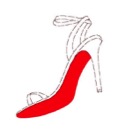 Mark Description: The trade mark is described as consisting “of the colour red (Pantone 18 1663TP) applied to the sole of a shoe as shown (the contour of the shoe is not part of the trade mark but is intended to show the positioning of the mark)”.
The Attorney General (AG) in the case makes it clear that while in the context of a colour per se, the colour is an aspect independent of the shape of the goods.[8] If however the application of the colour is dependent on the shape, for example because of changing dimensions or design of the product, the analysis will include the consideration that the functionality of the colour may emerge from its positioning on the goods.[9]
Accordingly, signs in which colours are integrated into the shape of the goods must be subject to the functionality analysis provided for by Article 3(1)(e) of the EU Directive 2008/95.[10]
This is a likely conclusion given that the amendments to the law made by Directive 2015[11] which are due to be implemented in January 2019. The new provision expands the scope of Article 3(1)(e) from its strict application to shape marks to marks consisting of “the shape, or another characteristic”, including colours.
Article 3(1)(e)[12] is an absolute ground for refusal for registering a trade mark. Under one of its three indents[13] a trade mark will not be registered if it consists exclusively of a characteristic (such as a colour), which gives ‘substantial value’ to the goods. This means that the mark consists exclusively of a characteristic that plays a very important part in the consumer’s purchasing choice. This provision ensures that features important to the success of goods on the market are not monopolised by one undertaking.[14]
Notably, the provision does not apply where the advantage does not derive from the intrinsic nature of the mark but from the reputation of the business or designer / maker.[15] In the case of Christian Louboutin, it was admitted that the colour red applied to the sole of a shoe gave substantial value to the shoes which reflected in their price. This ‘value’ however flowed from the reputation of the designer himself. Christian Louboutin’s trade mark of the red sole was held to be valid.
REPRESENTATION of Colour Marks
It is required that at the time of its filing for registration a mark must be capable of being represented on the register in a manner which enables those accessing the register to determine the clear and precise nature of the protection afforded to its proprietor.[16] For such representation to be valid it must meet what is known as the Sieckmann[17] criteria:
In order to fulfil its role as a registered trade mark … a sign’s representation on the register must be clear and precise, self-contained, easily accessible, intelligible, durable and objective.[18]
To meet the above list of requirements, a colour mark must be represented by a sample of the colour, a written description and an internationally recognised colour identification code.[19]
If the mark is a combination of colours it must also be “systematically arranged by associating the colours concerned in a predetermined and uniform way” [20] so that it can be “perceived unambiguously and in the same way” [21] which, in turn, will enable a consumer to repeat with certainty the experience of a purchase.
Representing a mark with a vague written description which uses terms like “approximately”[22] or “predominant”[23] may prevent the mark from registration or expose it to an invalidation action. A pictorial representation accompanying a vague description on the other hand will do very little to make up for the lack of certainty.[24] This has not always been the case as many marks on the register have vague descriptions but following a change in practice brought in 2015 [25] colour trade marks are more widely accepted as registrable but the requirement for ‘clarity and precision’ is also further reinforced. What this means for colour marks registered with a vague enough representation prior 2015 is that they could be vulnerable to an invalidation action as illustrated by the European Court of Justice’s decision in Glaxo v Sandoz[26] and Red Bull v Optimum Mark.
 Mark Description: Protection is claimed for the colours blue (Pantone 2747 C) and silver (Pantone 877 C) juxtaposed as shown in the representation of the colour mark applied for. The ratio of the colours is approximately 50%- 50%.
Closing Thoughts
Colour trade marks are a valuable addition to any trade mark portfolio. It would aid brand recognition and strengthen customer acquisition. However, it is important to recognise the obstacles that need to be overcome in registering a trade mark that consists exclusively of a colour or combination of colours. Showing acquired distinctiveness will mean that a brand must be able to show evidence of continuous and consistent use of a colour as a trade mark so to show that the colour applied for has acquired a new connotation in the mind of consumers.
FOOTNOTES
[1] ‘The Impact of Colour in Advertising, Marketing, and Design’ by David Gadsden (2014).
[2] Libertel Groep BV v Benelux-Merkenbureau (C-104/01) [2003] E.T.M.R. 63.
[3] Dyson v Registrar of Trade Marks [2007] R.P.C. 27.
[4] Cadbury UK Ltd v Comptroller General of Patents Designs and Trade Marks [2016] E.T.M.R. 33.
[5] Libertel, no.2 above.
[6] Cadbury, no.4 above.
[7] Christian Louboutin, Christian Louboutin SAS v Van Haren Schoenen BV [2018] E.T.M.R. 15.
[8] Christian Louboutin, Ibid. [56].
[9] Ibid. [57].
[10] Ibid. [58].
[11] EU Directive 2015/2436
[12] EU Directive 2008/95
[13] Art. 3(1)(e)(iii) EU Directive 2008/95
[14] Christian Louboutin, Ibid. [71]
[15] Ibid. [72]
[16] Art. 3 Directive 2015/2436
[17] Ralf Sieckmann v Deutches Patent-und Markenampt [2003] E.T.M.R. 37.
[18] Ibid.
[19] Rule 3(5) CTMIR 2868/95
[20] Heidelberger Bauchemie GmbH’s Trade Mark Application (C-49/02) [2004] E.T.M.R. 99.
[21] Ralf Sieckmann, no.17 above.
[22] Red Bull GmbH v Optimum Mark (R2037/2013).
[23] Societe des Produits Nestlé SA v Cadbury UK Ltd [2014] E.T.M.R. 3.
[24] Glaxo Wellcome UK Ltd v Sandoz Ltd [2017] E.T.M.R. 27 (CA (Civ Div)).
[25] Directive 2015/2436
[26] Glaxo Wellcome UK Ltd v Sandoz Ltd [2017] E.T.M.R. 27 (CA (Civ Div)); Red Bull GmbH v Optimum Mark (R2037/2013).
 tradeinsignatures.com
Leave a comment