
The Disney magic started at a small animation film studio named Lough-O-Grams, founded by Walt Disney at the age of 20. Closing its doors after a year, the studio had already set the foundations of what was to become The Walt Disney Company.
Almost a century later, the company had accumulated one of the most fascinating collections of creative works, technological developments and merchandise, including content from Pixar Animation, Marvel Entertainment & Lucasfilm. In 2015 Disney was the registered owner of 2257 patents and 2287 trade marks. [1] This article aims to provide a glimpse into the factors that have contributed to the growth and evolution of Disney’s IP portfolio.
Oswald & Mickey
DISNEY IP FOUNDATIONS
Before Mickey, there was Oswald. Disney lost the rights to Oswald when a business deal fell apart. To make matters worse, a large part of his creative team left along with Oswald.
The loss enthused the creation of a new character that was going to give the company a new life. Inspired by the shape of Oswald but with ears a little rounder, nose elongated, a long tail and a pair of white showman’s gloves, the look of Mickey Mouse emerged.
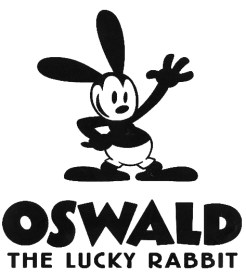
The key difference was that, unlike Oswald, who was more of a rogue, Mickey had a venturesome but charming personality. After the premier of Steamboat Willie in 1928, where Mickey made his first appearance, the company bloomed and Mickey was to become Disney’s alter ego throughout his career.
In 2006 Disney’s Bob Igner, CEO since 2005, negotiated the return of the rights over Oswald from Universal Studios in exchange for the sports commentator Al Michaels whose contract was with ESPN, a platform now acquired by Disney. It was an unusual trade but one that had a sentimental value for Disney.
It comes as no surprise that the character of Mickey Mouse has been dubbed an outlier in intellectual property protection as far as cartoon characters go. [2] Mickey not only has so called ‘secondary meaning’ in that it evokes immediate association with Disney, but is, in essence, Disney. There is not a more profound way of illustrating his recognition than with a star on the Hollywood Walk of Fame, the first one to be received by a cartoon character, as early as 1978.
With Mickey’s copyright protection in the US expected to expire in 2023, he will have his trade mark registration keeping him under the realm of Disney and away from exploitation by others once, and if, he reaches the public domain.
Growth
KEY ACQUISITIONS & PARTNERSHIPS
Since 2005, with a change of leadership from Michael Eisner to Bob Igner, there has been a strong focus on mergers and aquisitions as a way of growing Disney’s creative portfolio and output. The Disney Company today is a two-stream structure. ABC handles all TV and broadcasting platforms for the company while Disney handles all theme parks, film production and merchandise. The synergy between the two empowers Disney to utilise its existing IP as a way of curating new IP.
| Studio Entertainment
Disney’s leading acquisition is of Pixar Entertainment in 2006. This deal meant a creative boost for Disney, which it needed at a time when cinematic trends in animation were changing in an embrace of the digital era. The mix of these two studios proved so successful that Bob Igner invested into a few more: Marvel Entertainment in 2009; Lucasfilm in 2012; and Maker Studio in 2014. Marvel, a comic book company, brought under the Disney umbrella Captain America, Iron Man, Spider Man, X-Man and The Avengers. Lucasfilm brought Indiana Jones and, more notably, Star Wars. Maker Studio, a YouTube Multi-channel network, welcomed Disney to the world of viral online videos.
| Consumer Products
Disney Consumer Products, Inc. is said to be the world’s leading licensor. [3] Each new Disney production attracts a network of licensing partners. In the anticipation for the premier of “Beauty and the Beast” Disney partnered up with Unilever, Comparethemarket.com, Olay, Persil and Sony Mobiles. Each of which incorporated the movie into their own promotion packs. A similar strategy has been employed for the release of Disney Pixar’s film animation “Cars”, in partnering with Tesco Mobiles and Duracell in their TV advertisements.
| TV Channels
The Disney Company was one of the first to exploit television as an entertainment platform, although initially it was used as the means with which to fund Walt Disney’s construction of Disneyland. In 1955, Disney recorded his first series with ABC TV. The focus was on introducing animation as an art form in itself and an insight into the plans for Disneyland. This created an incredible level of anticipation for the opening of Disneyland.

The Disney Channel was launched in 1983 and the Disney Company eventually acquired ABC in 1995.
DISNEY INNOVATION
A skilled illustrator by hand and a visionary at heart, Walt Disney the man, advocated for innovation, experimentation and new directions in animation. Today the Company continues his enthusiasm for innovation and one of the means is via its Walt Disney Imagineering Research & Development, Inc division. Developments in Disney’s history include:
1934 | The Multiplane Camera
Conceived by Ub Iwerks and developed by William Garity, the multiplane camera creates the illusion of movement in drawn images. It uses four layers of flat artwork, stacked on top of each other, where in moving the layers closer and further from each other, different dimensions were created.[4] Disney used the multiplane camera to make “Snow White”.
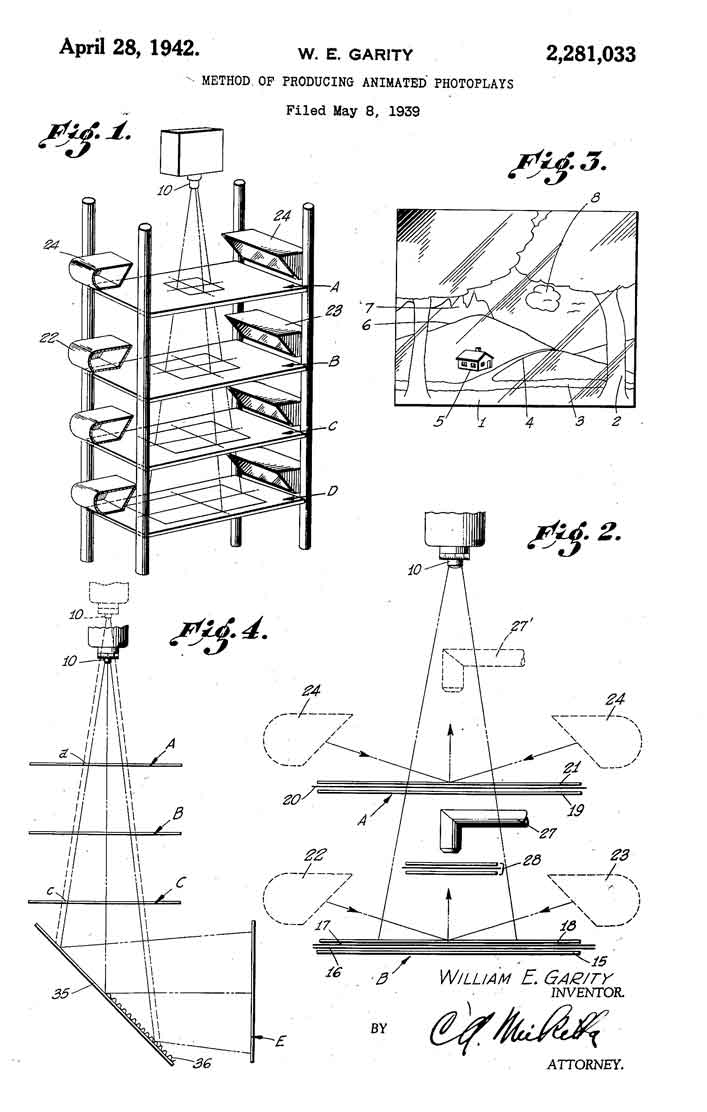 The early version of the Multiplane Camera as patented in 1942.
1937 | First Feature-Length Animated Film
Disney’s ‘Snow White and the Seven Dwarfs’, also known as “Disney’s folly”, was the first feature-length animated movie. It is said to be one of Disney’s most ambitious achievements in his early career, due to the sheer detail of expression in the story. Its completion had required around 200,000 illustrations before each scene captured the movement and emotion Disney envisioned.
1961 | Audio-Animatronics
Developed by Lee Adams, an employee at the Disney studio, this early form of robotics re-created characters as interactive 3D attractions. The term ‘audio-animatronics’ was filed as a trade mark by Disney in 1964.
 Minie Mouse patent filed in 1931.
1966 | First Full-Length, 3D Computer Animated Movie
Evolving from its tradition of hand-drawn animation, Disney embraced computer generated animation. As a joint-venture between Pixar, then headed by Steve Jobs, and Disney was the creation of Toy Story. Toy Story wins a Guinness World Record title as the First Feature-Length Computer Animated Movie. In 2006 Disney acquired Pixar in what was the most lucrative deal in animation history.
“I’d always say ‘hey can we do this?’ They’d say ‘no, but let’s try’.”
John Lasseter, creative director of Toy Story
2016 | Disney Movies VR App
In co-operation with Oculus Rift, the Disney Studio has launched the Disney Movies Virtual Reality App. The app sends a strong hint of Disney’s interest in VR as an upcoming media platform. The studio is also one of the main investors in virtual-reality start-up company Jaunt VR, which had secured an impressive $66 million in its Series C round of funding.
2016 | Makeup Lamps
Innovative in every step of the journey, Disney’s Research team’s latest quirk comes in light of its “Makeup Lamps”. A facial mapping technology that achieves the digital illusion of makeup, showcased by Lady Gaga’s tribute to David Bowie in 2016’s Grammys.
| The Disney Accelerator Program
In 2014, Disney partnered up with Techstarts in launching the Disney Accelerator programme to assist entrepreneurs in disruptive media and entertainment experience innovations technologically and creatively. The programme typically selects 10 startups each year with 11 making up the 2017 line up.
“Our business has grown with and by technological achievements. Should this technical progress ever come to a full stop, prepare the funeral oration for our medium.”
Walt Disney, “Growing Pains”
Disney Citizenship
Every intellectual property portfolio is strengthened by, and in fact its value is much dependent on, the brand’s reputation and actions. Since 2009 Disney has embraced the image of an environmentally friendly conglomerate, embarking on a wide range of initiatives, including:
_ the launch of a Mickey shaped five-megawatt solar facility, located on 22 acres with 48,000 solar panels.
_ Disney Resort train rides’ use of biodiesel made with recycled cooking oil from the resort’s restaurants and hotels.
_ the establishment of the Disney Conservation Fund (DCF) in 1995 and its support for non-profit organisations around the world. DCF also runs programs that motivate families to undertake conservation work for wildlife and habitats. More notably, it takes an initiative to connect children with nature.
_ the Disney Cruise Line’s ranking as the most environmentally friendly line by Friends of the Earth in 2013.
In 2016 Disney reports that it has reduced its overall emissions by 37% from 2012 figures.
“If we don’t act in accordance with the stories we tell, the experiences we offer, and the images we project, we lose our authenticity. You can’t entertain a family on the one hand and then totally disregard the world and circumstances in which they live. Acting responsibly is core to our brand.”
Jay Rasulo, CFO
CLOSING THOUGHTS
Today’s interaction between brands and the public has become more personal than it was ever imaginable. Continuous social media interaction, news and events push brands to be transparent, approachable and edgy. The change in social structures is reflected through corporate structures. Larger companies are seeing competition from much smaller companies simply because they resonate with the changing outlook of the younger generation. Banksy’s show, Dismaland, in 2015 illustrated this particular trend in a dramatic but compelling manner. It is Disney’s strategy thereby to be as current, relevant and tolerant to change without loosing its essence.
It can be said that although a legacy brand, [5] Disney is not a tale but a story that is still unravelling. It learns from conventional wisdom but its focus remains with creativity and technological innovation. That has been the means to maintaining the Disney magic.
[1] ‘Disney leverages entertainment IP for business success’ by Steve Brachman, IP Watchdog Blog.
[2] ‘Mickey’s Headed to the Public Domain! But Will He Go Quietly?’ by Sthephen Carlisle.
[3] License Global Annual Report 2017
[4] ‘How Disney Used the Multiplane Camera to Make Snow White and the Seven Dwarfs’ by Danette Watt
[5] ‘How Disney Maintains a Strong Relationship with its Millennial Audience’ by Sami Main, AdWeek.
Topic Reads
‘The Mouse Machine, Disney and Technology’ by J.P. Telotte
‘How Brands Become Icons, The Principles of Cultural Branding’ by Doughlas B. Holt
 tradeinsignatures.com
Leave a comment